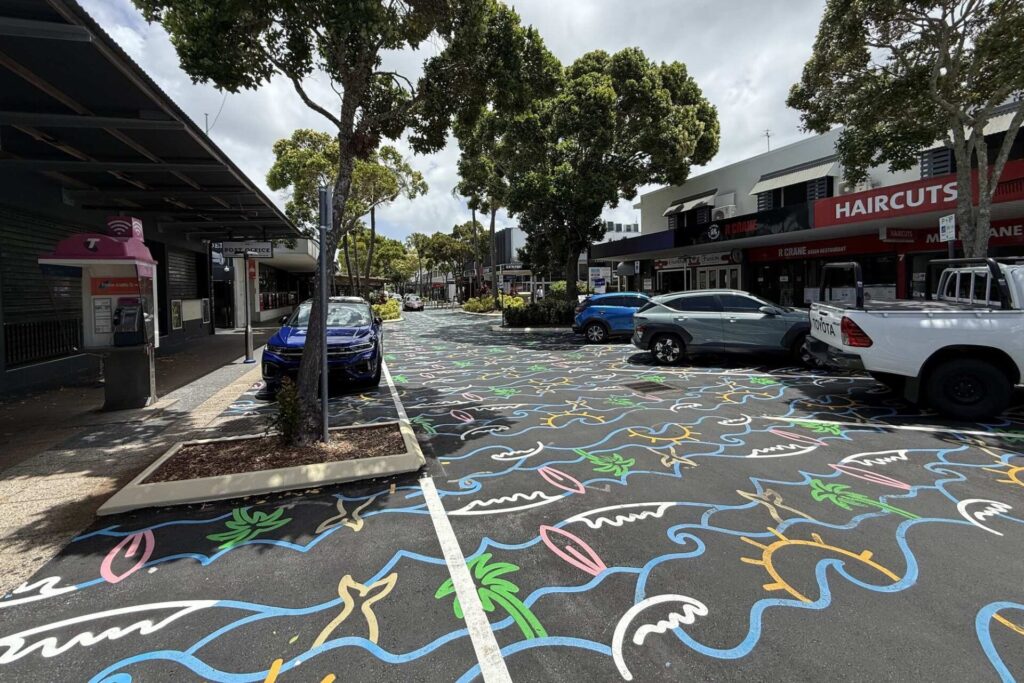
Ah, Ocean Street, Maroochydore. The vibrant heart of the Sunshine Coast’s entertainment precinct. Pristine tunes, lively bars, and… a rather distinctive new look for its shared street. If you’ve ventured into Maroochydore lately, you might have noticed that the familiar tarmac has been replaced by a kaleidoscope of squiggles, surfboards, and palm trees. The Sunshine Coast Council, bless their cotton socks, has rolled out a “refresh” of the shared street, aiming for a “vibrant coastal experience.”
But has this artistic endeavour, which spans the length of the street, truly hit the mark, or has it painted itself into a corner? Let’s dive into this colourful controversy with a bit of a wink and a nudge.
The Vision (Apparently): Safety and Sparkle
According to the Council, this approximately $700,000 Placemaking Renewal—which also includes new lighting and furniture—was a direct response to local businesses asking for a revitalisation of the precinct, particularly to support the night-time economy.
The design itself serves a dual, critical purpose:
-
Safety: The highly visible, bright mural is designed to reinforce the shared zone and visually remind drivers to slow down and give way to the hordes of pedestrians. In a busy nightlife and dining hub, this is a genuinely important function.
-
Vibrancy: It’s intended to evoke Maroochydore’s sun, surf, and sand identity, injecting a dose of energy and fun into the streetscape, making it a more “welcoming destination.”
The “Eyesore” Argument (with tongue firmly in cheek)
Now, let’s address the elephant in the room—or rather, the giant pink surfboard on the tarmac. From certain perspectives, this new iteration can feel less like a thoughtful safety feature and more like a runaway trolley of glitter and neon paint.
-
Visual Overload and Chaos: The sheer density of motifs—waves, surfboards, palm trees, suns, and marine life—creates a busy, almost chaotic scene. As seen in the images, the vibrant, repetitive patterns dominate the streetscape. While this is intentional to grab a driver’s attention (thus slowing them down), it risks distracting from the surrounding businesses and the area’s existing character. Is it an aesthetic backdrop for dining, or is it a headache-inducing wallpaper?
-
A Local Insight: Some keen observers have suggested that the swirling blue lines and abstract suns bear a curious resemblance to the kind of meteorological patterns one might see on a weather map—perhaps a subconscious design influence harkening back to Mayor Rosanna Natoli’s highly successful “weather girl” days before she traded in the evening forecast for the Mayoralty. We can only assume she approved the tropical cyclone of colour!
-
Aesthetics vs. Authenticity: Ocean Street is an urban hub. Does a highly stylised, almost cartoonish pattern truly reflect the sophisticated charm and bustling urban feel of the city centre? Some might argue it leans more towards a tourist trap souvenir than a key urban spine of the Principal Regional Activity Centre.
-
The Fading Factor: The council has wisely used a durable surface treatment, but street art in a high-traffic zone is still fighting a losing battle against the relentless Sunshine Coast sun and tyre marks. One can only imagine the patchy, chipped mosaic it might become over time, transforming from “vibrant coastal experience” to “slightly sad coastal memory.”
-
A Case of Street “Vandalism”?: While certainly a sanctioned, commissioned piece, the bold, in-your-face application of the art has led some to jokingly (or not-so-jokingly) wonder how this passed the urban design committee. It’s a statement piece, but one that has certainly polarised opinions on what constitutes acceptable public street art.
Fixing the “Faux Pas” (Playfully Speaking)
If the council were to consider a second refresh, how could they hit the safety and vibrancy goals without this visual shock and awe?
-
Tonal Consistency: Achieve the safety function with highly defined geometry and colour, but perhaps use a more muted, sophisticated palette that complements the surrounding architecture rather than clashing with it.
-
Art as Interruption, Not Dominance: Instead of painting the entire street, the art could be confined to highly visible intersections, pedestrian crossings, or central gathering nodes. This provides the necessary visual interruption to slow traffic without turning the entire road into a massive, repetitive mural.
-
The Power of Light: The council is adding new lighting, and this is where the real magic can happen. Subtle gobo projections or colour-changing LEDs could be used to create a dynamic, ever-changing atmosphere at night, removing the need for such jarring, permanent street-level colour.
The Million-Dollar Question (Well, the $700,000 Question)
Finally, the question on every local’s mind: Did Sunshine Coast ratepayers foot the entire bill for this asphalt adventure?
Given that the project cost is reported to be around $700,000 (a significant investment in a single street refresh), we sincerely hope that the council has maximised grant funding or leveraged other non-ratepayer revenue sources for this particular burst of creative expression. While placemaking is vital, residents rely on their rates for core services—and one hopes this colourful canvas didn’t come at the expense of necessary road or infrastructure maintenance elsewhere.
The Maroochydore Ocean Street refresh is undeniably a talking point. Whether you view it as a daring design triumph or a questionable urban artwork, it certainly adds flair to the area. It’s a bold move with a clear safety objective, but the resulting aesthetic has certainly given the Sunshine Coast something to cheerfully debate over their next Ocean Street coffee (or cocktail).
What do you think? Is it a vibrant, necessary addition, or a visual vexation? Let us know in the comments below!