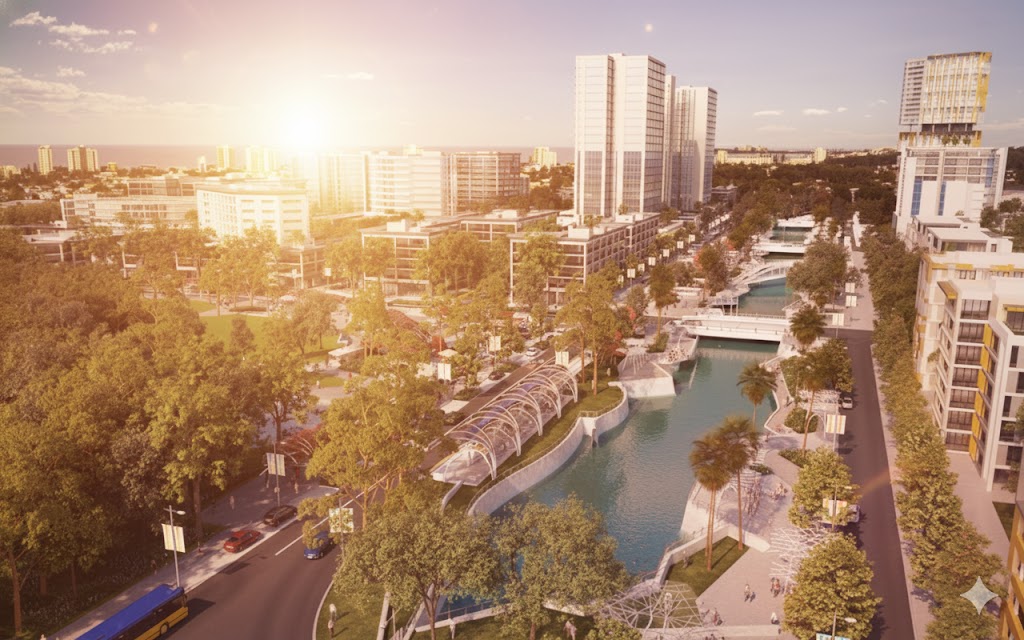
Once upon a time, in a Maroochydore far, far away (well, the 1920s), a generous fellow named Robert Ernest Horton looked out over 53 hectares of prime Sunshine Coast soil and thought, “You know what this town needs? A place for people to hit small white balls into holes.”
In 1930, he formalised this vision by gifting the land to the community. The Horton Trust was born, explicitly stating the land was for “golf and other recreation.” It was the ultimate “green lung”—a philanthropic “thank you” to the community that had welcomed him.
Fast forward to today, and if Robert Horton were to stroll down Aerodrome Road, he’d likely drop his hickory-shafted niblick in shock. The “green lung” is currently undergoing a radical transplant, replaced by a $2.5 billion “Smart City” featuring glass towers, automated underground trash chutes, and more concrete than a Roman freeway.
A Fairway to Heaven: The Golfing Glory Years
For sixty years, the Horton Park Golf Club was the heart of the community. It was a place where deals were made in the clubhouse and balls were lost in the scrub. By 2005, it was Queensland’s Regional Golf Club of the Year. It was, by all accounts, exactly what Robert Horton had ordered: a sprawling, 18-hole championship layout that kept the urban sprawl of the Sunshine Plaza at a polite distance.
The “Strategic Shift” (Or: How to Move a Golf Course)
As Maroochydore grew, planners began to look at those 53 hectares of manicured grass with hungry eyes. To a developer, a golf course in the middle of a city isn’t “recreation”—it’s “underutilized space.”
The dilemma was awkward: How do you take a gifted community trust and turn it into a high-density concrete jungle?
The answer: A $42 million “landmark agreement” and a bit of legal gymnastics. In 2011, the Council used the Acquisition of Land Act 1967 to resume the site. The golfers were packed off to Bli Bli (now the Maroochy River Golf Club), and the Council took the keys to the kingdom on January 27, 2012.
From Bunkers to Business Districts
The transformation, managed by SunCentral, is being billed as the only “greenfield CBD development” in Australia. It’s a bold vision. We’re talking:
-
150,000 sqm of commercial space (hello, Council Chambers!).
-
Up to 4,000 apartments (for those who love that “central” lifestyle).
-
A “Smart City” infrastructure featuring a sub-sea data cable.
But what about Robert Horton’s original wish?
The Council’s “tongue-in-cheek” nod to the original trust is the promise that 40% of the site will remain open space. Of course, “open space” in 2026 looks a little different than it did in 1930. Instead of 53 hectares of rolling fairways, we’re getting “linear parklands” and “waterway corridors.” It’s recreation, Jim, but not as Robert knew it. It’s less “fore!” and more “four-story atrium.”
Was the Public Interest Managed Correctly?
This is where the debate gets spicy. Proponents argue that a 21st-century city needs jobs and density, not a private club for 800 golfers in the middle of the CBD. They claim the “highest order” of use for the land is economic growth—to the tune of $5.9 billion.
Critics, however, point to the “moral shadow” of the 1930 Trust. There’s a certain irony in taking a gift intended to prevent over-development and using it to build the highest density towers on the Coast. While the new parkland will be lovely for a lunchtime sandwich, it’s a far cry from the “green lung” Robert Horton envisioned.
The Verdict: A Modern Legacy
The Maroochydore CBD is, without a doubt, an engineering marvel and a bold step for the Sunshine Coast. It’s shiny, it’s smart, and it’s very, very tall.
Whether the “spirit” of the gift has been honoured depends on your perspective. If you think Robert Horton would have loved a luxury apartment with high-speed internet and an automated bin system, then it’s a roaring success. If you think he just wanted a place for the community to stretch their legs and lose a golf ball… well, at least we kept his name on the street signs.